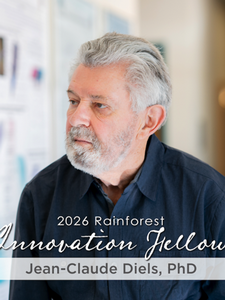
Jean-Claude Diels, PhD – 2026 Rainforest Innovation Fellow
Departmental News
Posted: May 18, 2026
This year we are proud to honor Dr. Jean-Claude Diels, a visionary whose career has been defined by a relentless, and occasionally explosive, pursuit of scientific discovery. Born in Belgium and influenced by a father who was a chemical engineer, Dr. Diels’ path took him from the early construction of CO2 lasers during military service to pioneering research at institutions like Philips Gloeilampenfabriek and the Max Planck Institute. Since joining the University of New Mexico in 1986, he has graduated 59 PhD students and authored seminal textbooks on ultrashort laser pulse phenomena. He is currently a Professor in the UNM Departments of Physics & Astronomy and Electrical & Computer Engineering. His work has fundamentally reshaped our understanding of the laser as a sensor, leading to breakthroughs in the measurement of rotation, acceleration, and magnetic fields through miniaturization. His impact is perhaps best illustrated by his designation as a ScholarGPS Highly Ranked Scholar, placing him in the top 0.05% of scholars worldwide based on his productivity and the influence of his publications.
Beyond the laboratory, Dr. Diels is a master of translating complex science for the public. His research into “laser-induced lightning” has been featured on the Discovery and History Channels, and his book, “Lasers: The Power and Precision of Light,” earned the 2013 CHOICE Award for Outstanding Academic Title. From his early days
experimenting with CO 2 lasers during military service to his modern collaborations spanning from Switzerland to Mexico, Dr. Diels has remained at the forefront of his field. It is our distinct honor to recognize his lifetime of research excellence and his enduring contributions to the University of New Mexico.
Dr. Diels earned his MS in Physics Engineering, followed by a Ph.D. in Physics from the University of California, Berkeley, in 1973 under the mentorship of E. L. Hahn. His additional awards and recognitions include the 51 st Annual Research Lecturer at the University of New Mexico (one of the highest honors UNM bestows upon its faculty); Engineering Excellence Award from the Optical Society of America (OSA); Fellow of the Optical Society of America (now Optica); Senior Member of the Institute of Electrical and Electronics Engineering (IEEE); and Fellow of the Belgian-American Educational Foundation; among other recognitions.
“Jean-Claude Diels has never been one to follow the well-worn path. Throughout his storied career, he has tackled science’s most fascinating problems with a rare blend of grit and imagination. Whether he is reaching into the clouds to trigger lightning with lasers or exploring the mysteries of gravitational waves on a lab bench, Jean-Claude’s work pushes the limits of what we know and what we can build. Perhaps his greatest legacy, however, is not found in a lab, but in the people he has shaped. He has devoted a lifetime to working side-by-side with his students, mentoring an extraordinary number of researchers who now lead the way in every corner of the global scientific community.”
– Wolfgang Rudolph, PhD, Regents’ Professor Emeritus, Department of Physics & Astronomy, The University of New Mexico
Video: Jean-Claude Diels – 2026 Rainforest Innovation Fellow
An Innovator’s Journey
I am Jean-Claude Diels, better known as the husband of Marlies Diels, a local ceramic artist who received the 2025 Treasurers Award of Albuquerque, and the Father of Natacha Diels, well known composer and performer of New Music, winner of the 2026 Arts and Letters Music Award. I was born and raised in Belgium, a country that has been the battlefield of Europe over the centuries. That is why it was forbidden to sing the national anthem in schools and patriotism believed to be the root of wars. Unlike Americans, we are not taught that we are superior to the rest of the world (even though
we are). My father was a chemical engineer. He taught me very early how to cut big trees with dynamite sticks. I followed his steps in engineering, but instead of chemistry, my self-destructive instincts steered me towards electricity and magnetism.
Probably trying to recover my whole life for having flunked miserably the course taught by a terrorizing Professor. I tried to grasp for the first time the concept of electricity while constructing the first CO2 laser of the Belgium army as part of my military service. I grasped it all right: 15000 V out of the case of the 4th of 3 kV power supplies connected in series. I learned that 10 mA can make deep holes through your fingers. Maybe that inspired my first patent about triggering lightning with lasers. I succeeded in attracting lightning all right. In 1998, on travel to the International Conference on Laser Induced Lightning, the control tower of Cincinnati got hit by lightning. As I was flying a Cessna 340 N789SC to New York in June 2003, lightning struck the right propeller, went through the engine shaft and exited through the tail ($50,000 repair). As I prepared a talk on laser induced lightning for the University of Strasbourg (September 2005), a lightning
strike zapped my laptop. I still hope to have the last word with a new patent application on laser induced lightning to be led this year.
But lightning and explosives are not my only interests. I started my career in research constructing a CO 2 laser as part of my long year military service (too long) in Belgium. Thereafter, I spent 5 years (much too long) as a Research Scientist in the fundamental research laboratories of Philips Gloelampenfabrik in Eindhoven, with an assignment to do “modern research” with an “unlimited budget” (which I was soon accused to have exceeded). I spent the next 3 years (way too short) to do Ph.D. thesis research on coherent pulse propagation in two level systems with Professor Erwin L. Hahn at UC Berkeley. Some advice: when you have a good advisor, don’t rush to graduate. Stick to him as long as he can stand you. The next two years (too long) were spent at the Max Plank Institute with Professor Fritz Schaefer, the colorful (usually covered with red) father of dye lasers. Thereafter I got an appointment as an Associate Research Professor at the University of Southern California (What??? I have to raise my own salary?). After spending some time with Pierre Agostini at the Centre d’Energie Atomique of Saclay near Paris (not the Texan Paris), and before the collapse of the Center for Laser Studies at USC, I moved to the CAQE (Center for Applied Quantum Electronics) of the University of North Texas in Denton, where I survived the “friendly Texans” for 5 years (too long), interrupted by a (breath of fresh air) sabbatical at the University of Bordeaux, France. I have since been (much too long) at the University of New Mexico, where I graduated (so far) 59 PhD students.
My interests were not only in sending high power laser beams through the atmosphere. I realized soon, in the 90’s, that the laser itself is a sensor that can achieve much better performances than any interferometer coupled outside a laser cavity. This realization has led to patents related to sensing of acceleration, rotation, magnetic and electric fields, indices of refraction, and velocimetry. By measuring frequency rather than amplitude, we demonstrated a phase resolution of 0.4 × 10⁻⁹ radians, corresponding to an optical path change of just 0.07 femtometers. These results open the door to ultra-miniaturized sensing systems, including the possibility of a complete inertial navigation system within a 1 cm3 volume.
I co-authored with Wolfgang Rudolph the graduate textbook, “Ultrashort Laser Pulse Phenomena: Fundamentals, Techniques and Applications on a Femtosecond Time Scale,” and with Ladan Arissian the book, “Lasers: The Power and Precision of Light,” which celebrates the 50 th anniversary of the laser. I have published seven book chapters and edited a book on light filaments. I am the recipient of the 51 st Annual Research Lecturer Award (April 2006), and of the 2006 Engineering Excellence Award of the Optical Society of America and named a Highly Ranked Scholar by ScholarGPS.
“I often wonder whether Jean-Claude Diels would prefer to be remembered for his humor rather than his brilliance, for his humanity rather than his innovation. Yet regardless of that choice, what defines him most is his rare ability to see the world in a perpetually new light. He never chased the spotlight or the buzzwords of the moment; instead, he quietly redefined them—whether through a sketch, a cartoon, or an unexpected approach to measuring the world through electromagnetic waves. From world-record achievements in ultrashort laser pulses to ultra-precise sensors and interactivity phase interferometry, from lightning and electrical discharges to lasing in the atmosphere, he has explored an extraordinary range of phenomena. Quiet and shy by nature, he has never hesitated to venture into the unknown, consistently opening new paths where others saw boundaries. To many, he is the ‘lightning guy,’ but that phrase only hints at something deeper: a mind that illuminated science not only through precision, but through curiosity, playfulness, and an unwavering originality.”
– Ladan Arissian, PhD, Physicist, National Institute of Standards and Technology
Re-issued UNM Rainforest Innovations Story • Jean-Claude Diels, PhD – 2026 Rainforest Innovation Fellow